In short: a hairpin turn (hairpin bend, hairpin corner, or switchback in American English) is a bend so tight that you turn through about 180° and leave it heading back the way you came, like the shape of a bent hairpin. It is the slowest kind of corner. The fast way round: be on the outside edge before it, brake hard in a straight line, turn in late, clip the inside past the middle of the bend and get back on the throttle early, because the exit speed matters more than the entry. This track has one of 180° on 14 m at the end of its longest straight. What a hairpin is · the line here.
- target (3 laps)
- 1:40.00
- per lap
- 33.3 s
- record
- 0:51.54
- lap length
- 326 m
- width
- 22 m
- corners
- 5
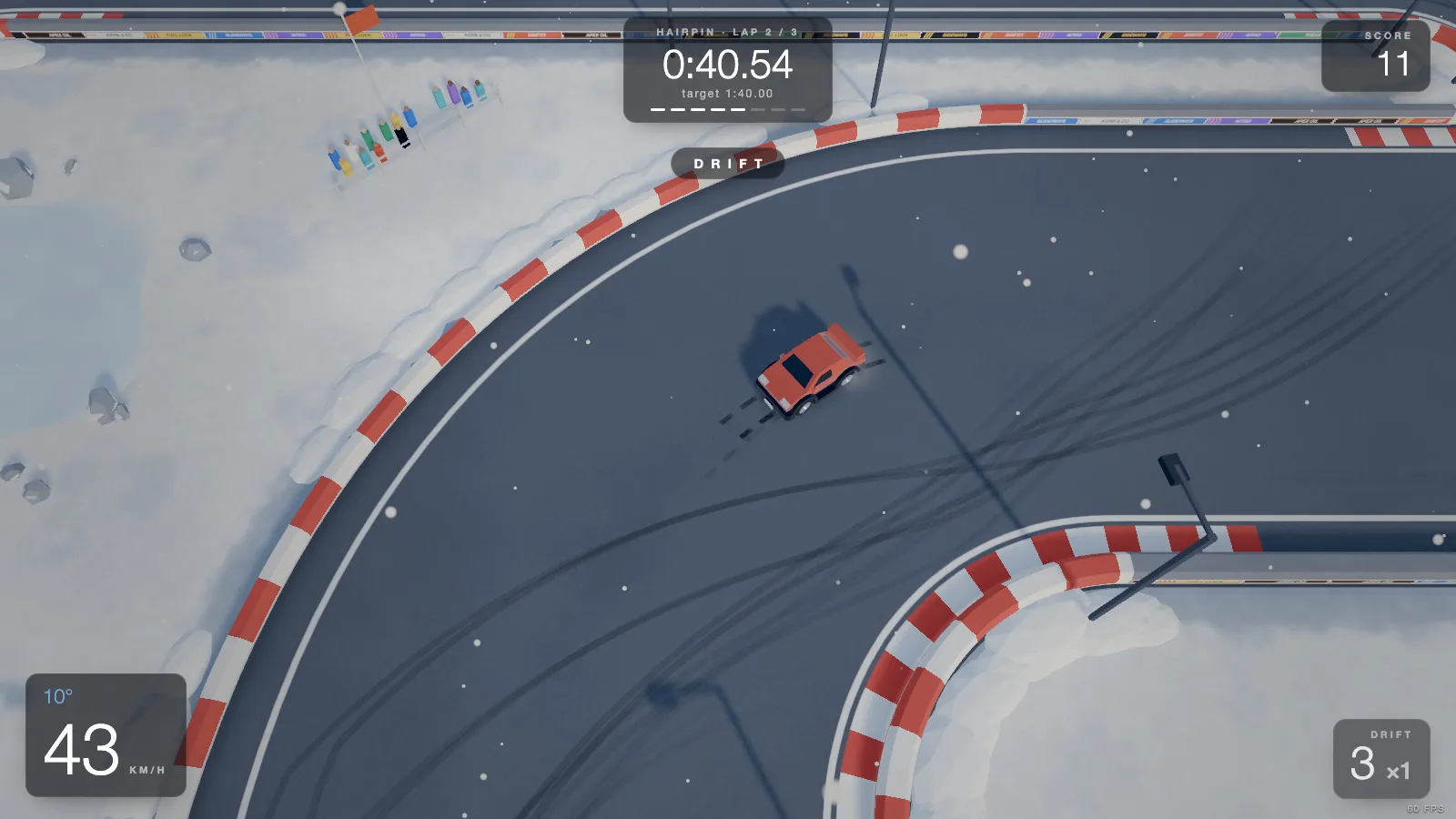
The map as the game's menu draws it, seen from above like the in-game camera. The dot is the start line.
Overview
Hairpin has 5 corners, 4 right-hand and 1 left-hand, turning through 540° in total on a 326 m lap. The tightest corner has a 14 m radius, and there is one hairpin. At 22 m wide it is one of the roomier tracks, forgiving while you learn to hold an angle.
To beat the target you need an average of 33.3 s a lap. Corners swap direction, so the transitions between them decide the lap.
Corner by corner
| # | Corner | Turns | Angle | Radius | How to take it |
|---|---|---|---|---|---|
| 1 | Sweeper | right | 90° | 24 m | Fast sweeper. Enter with speed and a small angle; too much angle here only costs time. |
| 2 | Hairpin | right | 180° | 14 m | Hairpin. Brake before it, flick the handbrake early and rotate the car hard; drive out on the throttle. |
| 3 | Left | left | 90° | 20 m | Medium. Tap in before the apex and hold a moderate angle with the throttle. |
| 4 | Right | right | 90° | 22 m | Fast sweeper. Enter with speed and a small angle; too much angle here only costs time. |
| 5 | Final | right | 90° | 22 m | Fast sweeper. Enter with speed and a small angle; too much angle here only costs time. |
What hairpins, chicanes and sweepers are and the line through each: corner types and how to drift them.
What is a hairpin turn? Roads, tracks and drifting
A hairpin turn is the tightest kind of corner there is: a bend that folds back on itself so you turn through about 180° and leave it heading the way you came. The name comes from its shape, a bent hairpin, seen from above. People also call it a hairpin bend or a hairpin corner, and in American English it is often a switchback.
On a road. Hairpins are how roads climb mountains. A car cannot drive straight up a steep slope, so the road zigzags across it, and every change of direction is a hairpin. The Alpine passes are full of them: the Stelvio Pass in Italy has 48 numbered hairpins on its north-eastern side. On a road hairpin the inside is far steeper and tighter than the outside, which is why lorries and buses swing wide to get round.
On a race track. A hairpin is the slowest corner of a lap, usually placed at the end of a straight. Monaco's Grand Hotel (Fairmont) hairpin is the best-known one in Formula 1, and La Source at Spa-Francorchamps is another. Every car brakes hard for a hairpin, so it is one of the classic places to overtake, and because you leave it at low speed, the exit decides your speed all the way down the next straight.
Hairpin, double hairpin or chicane? A double hairpin is two of them in a row in opposite directions (see Double Hairpin). A chicane is the opposite idea: a short wiggle that slows you down but hands you back on the same heading. A hairpin sends you back where you came from.
How to drive any hairpin. Get to the outside edge of the road before it, brake in a straight line while the car is still pointing straight, then turn in late and aim for the inside just past the middle of the bend. That late apex straightens the exit, so you can be back on the throttle while the car is still turning. Turning in early feels faster and is the usual mistake: the car runs wide on the way out, just when you want to accelerate.
The hairpin turn: racing line and drift
A hairpin is a bend that turns you through about 180°, so you leave it heading back the way you came. This track is built around one: a 90° right-hand sweeper (24 m) opens onto a 70 m straight, the longest on the lap, and at its end the road folds back in a 180° right-hander with a 14 m radius. After 20 m comes a 90° left (20 m), then two 22 m rights only 10 m apart lead back to the start line. The hint says it in four words: "Brake late, flick, hold."
The road is wider than the corner is tight. The road is 22 m wide and the hairpin is only 14 m to the middle of the road, so the inside wall wraps round on a 3 m radius and the outside wall on 25 m. That gap is the whole secret of a hairpin turn. Hug the inside and you drive round a 3 m circle at walking pace. Swing out to the left edge before you turn and you can drive an arc with nearly twice the radius of the middle of the road. As a rule of thumb, for the same grip the speed you can carry grows with the square root of the radius, so close to double the radius is about a third more speed through the turn.
Set it up two corners early. The outside of this right-hander is the left-hand side of the road, and the sweeper before the straight is also a right, so its natural exit already puts you on the left. Take the sweeper with one smooth apex, let the car run out to the left and stay there for all 70 m. Speed out of the sweeper is speed for the whole straight, which is why it matters more than the hairpin entry.
Brake late, in a straight line. Full brakes slow the car by 11 m/s², about 40 km/h every second, and the tyres lose part of their grip while you brake, so do the braking before you turn, not while turning. Late means using all 70 m of the straight, not braking inside the hairpin.
Apex late, exit in the middle. The classic hairpin line runs out to the far edge of the road on exit. Here that edge (the left) is the inside of the left-hander 20 m later, and 20 m is not enough road to cross 22 m and set up again. So turn in a little later than feels natural, find the inside of the hairpin past its middle, and let the car drift out only to the right half of the road. That is the outside of the left: you arrive placed, turn in, and carry on.
How to drift it: flick and hold. In a real car the flick is a feint: a short steer away from the corner, then hard into it, so the weight swings across and the rear lets go. DRIFTIT's grip model does not move weight between the axles, so in the game the flick that works is a brake-then-turn or a handbrake tap. Full brakes take about 30% off the rear's grip, so turning in as you come off the brakes already rotates the car. A tap of the handbrake is the bigger version: with it on, the rear keeps only about a tenth of its sideways grip and the car pivots almost at once (more on this in the feint drift). Then hold the angle with throttle and counter-steer all the way round; more throttle for more angle, less for less. At slow hairpin speeds the steering has plenty of lock (about 31° at 36 km/h, against 20° at 72 km/h), so you have room to catch the slide. Over-rotating is the usual mistake: the car points at the inside wall, and in DRIFTIT any wall touch ends the run.
The second half. The left after the hairpin and the right 10 m after it change direction, so take them as one transition: lift as the car passes straight, let the rear swing the other way and catch it. Done as one movement, the drift never breaks and the score multiplier keeps climbing. The last two 22 m rights are only 10 m apart, so treat them as one 180° turn and exit wide to the left, ready for the 34 m start straight and the sweeper.
The theory: corner types: hairpin and how to drift. Two in a row: Double Hairpin; two split by a chicane: Switchback.
FAQ
What is a hairpin turn?
A hairpin turn is a bend in a road or track so sharp that you turn through about 180 degrees and come out heading back the way you came. It is named after the shape of a bent hairpin. It is also called a hairpin bend or hairpin corner, and in American English often a switchback.
Why do mountain roads have hairpin turns?
A road cannot climb a steep slope straight up, so it zigzags across it. Each change of direction is a hairpin, which keeps the gradient low enough to drive. Famous examples are the Alpine passes such as the Stelvio, whose north-eastern side has 48 numbered hairpins.
What is a hairpin on a race track?
A very slow, roughly 180 degree corner, usually at the end of a straight. Monaco’s Grand Hotel (Fairmont) hairpin and La Source at Spa-Francorchamps are well-known ones. The heavy braking before a hairpin makes it one of the classic places to overtake.
What is the racing line through a hairpin?
Start from the outside edge, brake in a straight line, turn in later than feels natural and clip the inside past the middle of the bend (a late apex). That opens the exit, so you can get back on the throttle sooner and carry more speed down the next straight.
What is the difference between a hairpin and a switchback?
On roads they mean the same thing: a 180 degree bend, and switchback is the more common American word. In DRIFTIT, Switchback is the name of a track with two hairpins split by a chicane.
The record
The current record on Hairpin is 0:51.54 by @AndrewCourtney7, 48.5 s under the target, with 28 drivers on the board. Think you can beat it? Sign in with X in the game and your fastest run goes up under your @handle.
Tips
- Drive one clean lap first: any wall contact restarts the run, and your ghost only records runs you finish.
- Once you have a personal best, race its ghost and watch the checkpoint splits to find the corner that costs you time.
- Use the width: a wide entry lets you start the slide early and carry more speed through the apex.
- New to the technique? How to drift with a keyboard covers handbrake entry, counter-steer and linking.