This guide assumes you can already hold one steady drift. If not, start with how to drift, and read drifting explained if you want the grip physics behind every step below.
The idea: a pendulum
When a car drifts right, its tail is out to the left and the rear tyres are sliding. Take away whatever keeps them sliding and they grip again. A rear that grips pulls the car straight, and if the car is still rotating when it gets there, it carries on past straight and the tail swings out to the right. The car has swung like a pendulum, and you are now drifting left.
That is the whole trick. You do not throw the car into the second slide; you release the first one at the right moment and let the swing do most of the work. Your job is to time the release and catch the car on the other side.
The transition, step by step
- Set up before the corner ends. The swing takes time, so it starts while you are still in the first bend, roughly where you would begin to unwind the steering.
- Lift. Ease off the throttle, briefly. With less power the rear grips and the nose starts coming back. A short lift is a small swing; a long one is a big swing.
- Steer the new way as the car passes straight. Not before: steering early just pushes the first drift wider.
- Back on the throttle. As the tail swings across, power breaks the rear loose on the new side. On a tight change, a tap of the handbrake helps.
- Catch it. Counter-steer to stop the rotation at the angle you want, then hold it with the throttle as usual.
Rhythm matters more than force. In a series of bends every swing is the same move, so find a beat and keep it. One late swing makes the next one late too, and two corners later the car meets a wall.
The feint drift
A feint (often called the Scandinavian flick) is the transition used to start a drift. Before a right-hander, steer briefly left, then sharply right. In a real car the first steer loads the right-side tyres, the second throws the weight across, and the rear, momentarily light, lets go. You arrive at the corner already rotating, with no handbrake needed. Drivers use it for fast entries where the handbrake would scrub too much speed.
An honest note on games: a feint only works as well as the game models weight transfer. DRIFTIT's grip model does not move weight between the axles (the load transfer it computes only drives visual effects), so a pure steering feint cannot unload the rear tyres the way it does in a sim. The weight effect it does model is braking: full brakes take about 30% off the rear's grip. In DRIFTIT, the reliable entries are a handbrake tap, which leaves the rear with 10% of its grip almost instantly, or a brake-then-turn. Save the feint for games that simulate it, and compare it in a few in our list of drift games for PC.
The 0.6-second window
Every drift game needs a rule for when one drift ends and the next begins, because in a transition the angle has to pass through zero. DRIFTIT's rule:
- The car counts as drifting when the rear slides at more than 10° and it moves faster than 4 m/s (about 14 km/h).
- When it stops drifting, a clock starts. If the car drifts again within 0.6 s, nothing has happened: the points and the multiplier carry on. The multiplier's own timer simply pauses while you are not sliding.
- Past 0.6 s, the drift banks: its points times its multiplier go into your score and the multiplier drops back to ×1.
So a transition must take the car from 10° on one side to 10° on the other in under 0.6 s. Committed swings manage that easily. Lazy ones, where the car drives straight for a moment while you decide, do not. The angle on the HUD (bottom left) lights up in the track's colour while you are drifting and goes grey when you are not; in a good link it only flickers.
Here is what staying linked is worth. The multiplier climbs 0.5 every 1.5 s of drifting:
| Seconds of unbroken drift | 0 | 1.5 | 3 | 6 | 9 | 15 | 27 |
|---|---|---|---|---|---|---|---|
| Multiplier | ×1 | ×1.5 | ×2 | ×3 | ×4 | ×6 | ×10 |
A drift banked after one corner rarely gets past ×2. Link four or five and you are at ×4 or more, applied to every point in the slide. The full formula, with worked numbers, is in how drifting is scored. One warning: a wall ends a linked drift with nothing banked, however long it was.
Where to practise in DRIFTIT
Start on Chicane: its chicane is a single three-part wiggle, so you learn one transition at a time. Mirror Chicane is the same on a narrower track. Then move to the four tracks built on runs of alternating bends:
| Track | Alternating bends | Radius | Track width | Why |
|---|---|---|---|---|
| Esses | 4 (50°, 100°, 100°, 50°) | 18 m | 22 m | The gentlest start: the S opens and closes with half-size bends, so the first and last swings are small. |
| Snake | 4 (70°, 70°, 70°, 70°) | 20 m | 20 m | Equal bends on a roomier track than the next two. The rhythm drill: every swing is the same. |
| Long Right | 4 (70°, 70°, 70°, 70°) | 18 m | 18 m | The Snake idea on a tighter radius and a narrower track. Less room to be late. |
| Zigzag | 6 (60°, 60°, 60°, 60°, 60°, 60°) | 14 m | 17 m | The hardest: more swings in a row on the tightest radius of the four, on a narrow track. |
All of them are open from the start, and the corner data above comes straight from the game's track files. After the alternating section, each track carries on into a run of same-direction corners, which is a good place to practise holding the linked slide rather than swinging it.
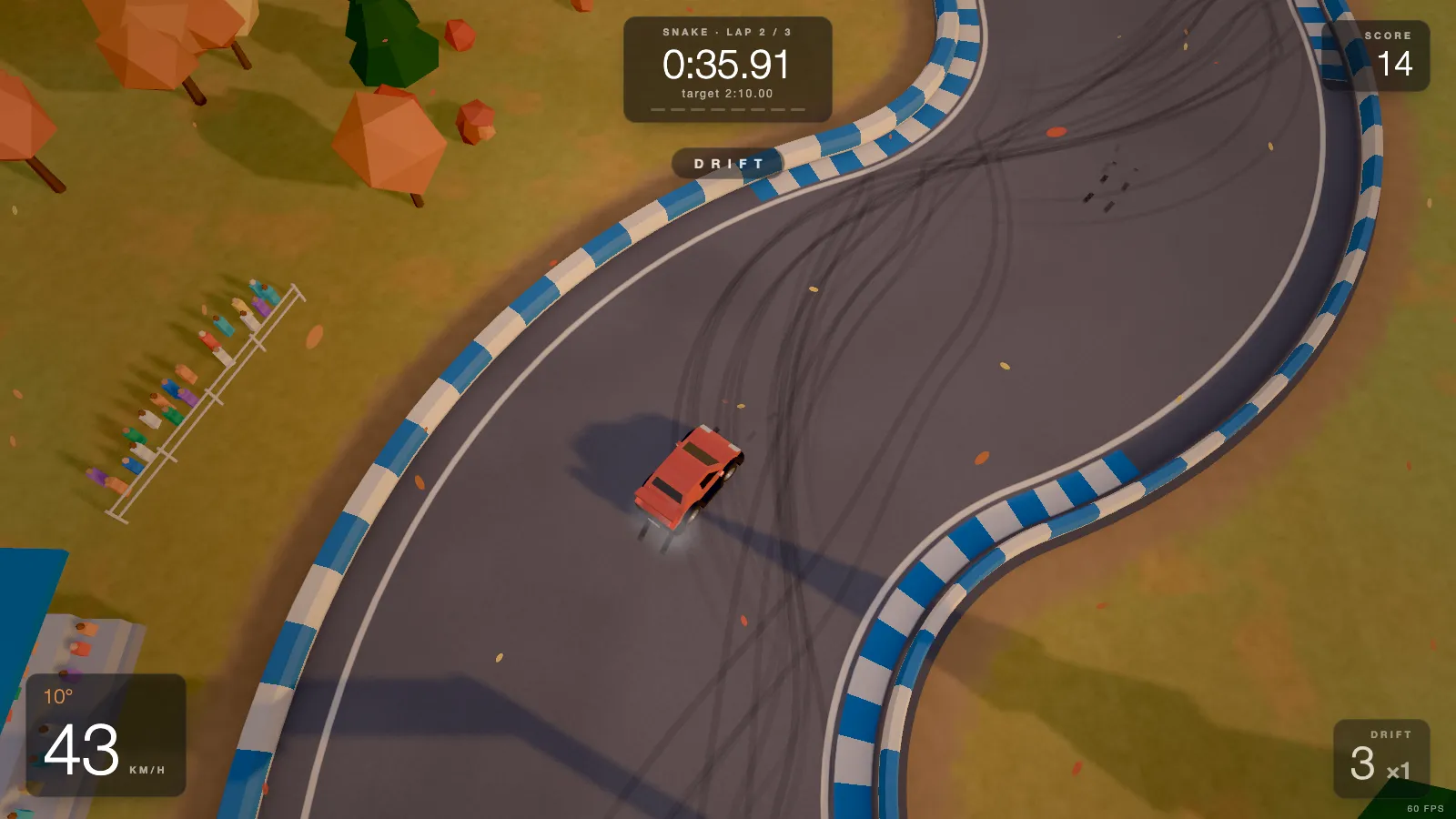
Snake: the alternating bends right after the start, then four corners turning the same way.
A drill that works
- Small angles first. On Snake, drift each bend at a shallow angle. Small angles mean small swings, and small swings are quick enough to stay inside the window.
- Watch the multiplier, not the angle. Your only goal for the first runs is a multiplier that keeps climbing through the whole section.
- Then add angle, one or two degrees at a time, until the swings start running late. Back off a little from there.
- Then speed. Points scale with speed, but so does the distance you cover while you wait for the swing.
On a controller the lift is a partial release of the trigger rather than a full one, which makes small swings much easier; see drifting with a controller.
Common mistakes
- No lift. Keeping full throttle through the change. The rear never grips, so the car does not swing back and you slide wide into the next bend.
- Lifting too long. The rear grips fully, the car drives straight, the window closes and the drift banks. In DRIFTIT the rear takes about half a second to hook up completely, so a lift of that length ends a slide.
- Steering the new way too early. It fights the swing instead of helping it.
- Letting go of the stick or keys. If the steering sits centred for about 0.4 s, DRIFTIT starts straightening the car for you. Keep a hand on it through the swing.
- Chasing angle on narrow tracks. Zigzag's 6 bends on 14 m are tight; a big angle there clips the wall on the next swing.