The three numbers that make a corner
A corner is described by its radius (how tight it is), its angle (how far it turns you) and what comes after it. The first two set how fast you can go through it. The third decides where to compromise. In DRIFTIT the radii run from 11 m (the tightest corners, on Tight) to 36 m (the Carousel), and the angles from a 45° flick to the 270° carousel.
The classic racing line is outside, inside, outside: come in wide, touch the inside at the apex, and let the car run out wide again on exit. That makes the arc you actually drive bigger than the corner, and a bigger arc is a faster one. Where exactly you put the apex changes with the corner type, and that is what the rest of this page is about.
Hairpin
A hairpin turns you through about 180° on a small radius. It is the slowest corner on most tracks and usually sits at the end of a long straight, which makes it the corner where you gain or lose the most. On the Hairpin track it is a 14 m, 180° right-hander at the end of a 70 m straight; 7 of the 20 tracks have at least one (Chicane, Hairpin, Double Hairpin, Mirror Chicane, Switchback, Endurance and Final).
The line: brake in a straight line, turn in late, apex late, exit straight. The time you lose on the way in is tiny compared with the time you gain on the straight after it.
How to drift it: this is where the handbrake earns its keep. Brake first, then turn in and tap Space early: with the handbrake on, the rear keeps only about 10% of its sideways grip and the car rotates almost on the spot. Let the rotation carry the nose round to the exit, counter-steer to stop it, and drive out on the throttle. Too much rotation is the classic mistake; you end up pointing at the inside wall and have to wait.
The Hairpin track: the long straight into the 14 m hairpin is the key to the lap.
Double hairpin
Two hairpins joined by a short straight, turning opposite ways. You cannot take both perfectly: the ideal exit from the first is the wrong entry for the second. On Double Hairpin both are 13 m and 180°, with only 14 m of straight between them.
The line: sacrifice the first. Turn in late and keep the car closer to the middle on exit, so you arrive at the second hairpin already on its outside. Take the second one properly: late apex, straight exit, full throttle. The exit of the second hairpin is the one that leads onto the straights, so it is the one worth getting right.
How to drift it: the track's own hint is "keep the rotation going". With so little straight in between, don't let the car fully straighten. Swing the angle across like a transition (see chicanes below): ease off the throttle as you leave the first hairpin, let the rear grip so the car swings back, and break it loose the other way for the second. Switchback has the same idea split by a chicane, on 12 m hairpins.
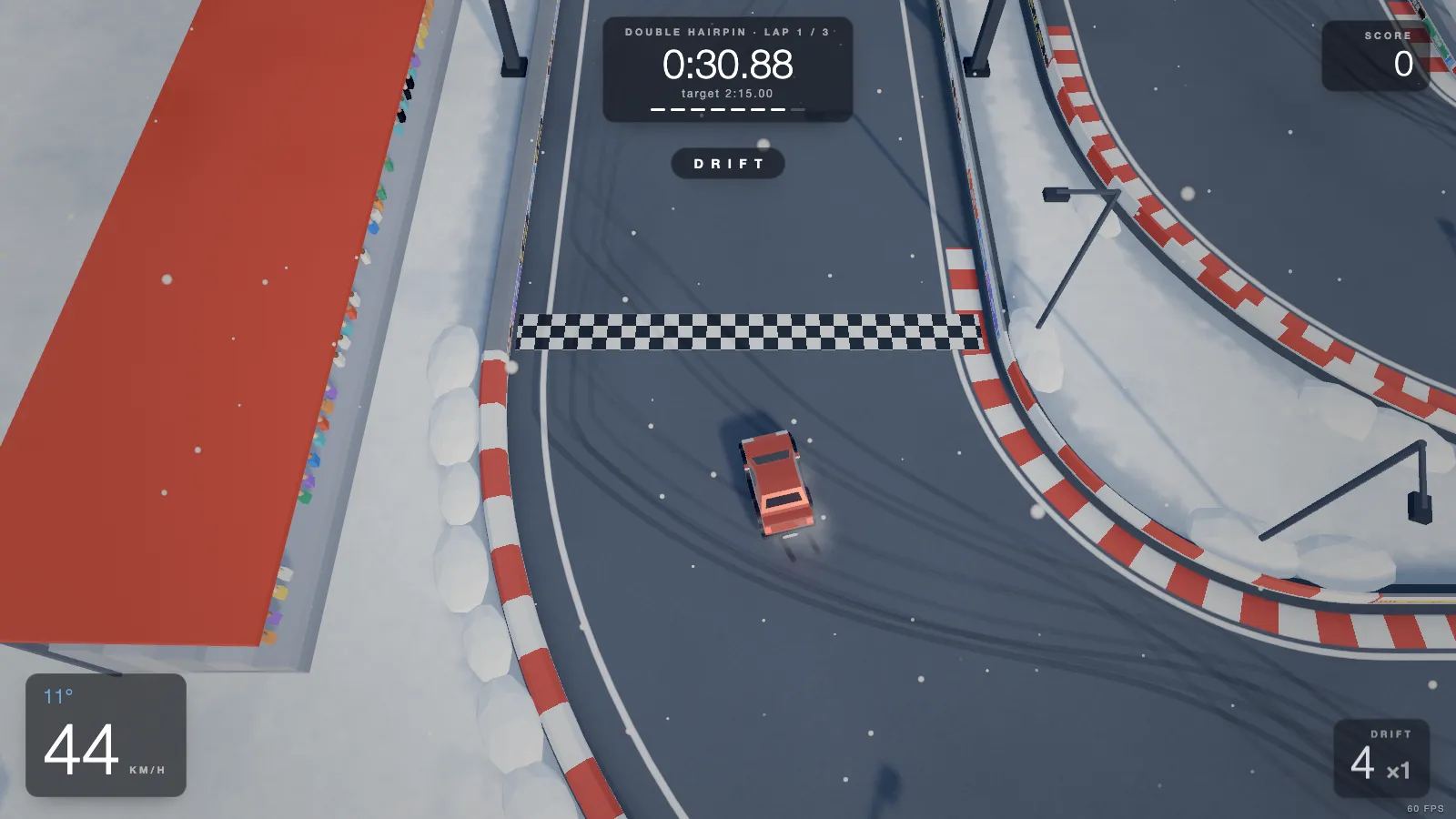
Double Hairpin: two 13 m hairpins in opposite directions, then four fast 22 m right-handers.
Chicane
A chicane is a quick wiggle: right-left-right or left-right-left, usually put into a straight to slow cars down. In DRIFTIT a chicane is three linked arcs that leave you pointing the same way you came in: on the Chicane track it is 45°, 90° and 45° on 18 m. 5 tracks have one: Chicane, Mirror Chicane, Switchback, Endurance and Final.
The line: as straight as the walls allow. The best line through a chicane cuts the wiggle down to a gentle curve, clipping each inside on the way. Brake before it, not in it.
How to drift it: a chicane is all transitions. Instead of one drift per bend, aim for one slide that swings from side to side: lift off briefly as the car passes straight, steer the new way, back on the throttle. The game's drift multiplier only climbs while a slide is unbroken, so a clean chicane is worth a lot of points. Keep the angle small; a wide slide here clips the wall on the next swing.
Esses
Esses are a longer run of alternating bends, a chicane that keeps going. On Esses it is four arcs on 18 m (50°, 100°, 100°, 50°), and Snake and Long Right open with four 70° bends that alternate the same way. Zigzag pushes it to six 60° flicks on 14 m.
The line: think about the exit of the whole sequence, not each bend. Usually you give up a little on the first bends to be in the right place for the last one.
How to drift it: rhythm. Each transition is the same move (lift, swing, throttle), so find a beat and keep it. If you get one swing late, the next one comes too late as well, and the slide ends against a wall two bends later. Smaller angles make the rhythm easier.
Esses: the four-part S right after the start, then four 20 m right-handers.
Sweeper
A sweeper is a long, wide bend taken fast. The Oval is nothing but two 24 m, 180° sweepers; 7 tracks have a corner called a sweeper (Oval, Chicane, Hairpin, Kidney, Mirror Chicane, Endurance and Final).
The line: smooth, wide, one apex. A sweeper punishes sudden inputs more than any other corner, because at high speed every correction costs grip.
How to drift it: one long slide at a shallow angle. Get it started at the entry, then hold it with the throttle: more throttle for more angle, less for less. The car's steering lock shrinks with speed (about 20° at 72 km/h and 7° at 160 km/h), so fast sweepers want small, early inputs. This is the corner where your drift score builds the longest, and also where too much angle quietly costs the most time.
Carousel
A carousel is a sweeper that doesn't end: a long, constant-radius bend of well over 180°. The Carousel track is built around one: 270° on a 36 m radius, the widest corner in the game, followed by a sharp 14 m exit.
The line: constant radius, so a constant line. Settle the car early and change as little as possible until you can see the exit.
How to drift it: the track's hint says it: "settle the angle and ride it out". Pick an angle, hold the throttle steady and let the counter-steer do its work. The hard part is the tight exit straight after it: lift early enough to make it.
Kinks and flicks
A kink is barely a corner: a small change of direction you can often take flat out. On Kidney it is a 60°, 120°, 60° wiggle on 18 m between two sweepers. A flick is a short bend against the direction of the corners around it, like the 45° flick left on Sweepers that comes straight out of a 135° right-hander.
How to drift it: use it to swing the car's weight rather than to slow down. On Kidney the hint warns "do not lift too early": the kink costs less time than braking for it.
Decreasing-radius corners
A corner that gets tighter as you go is the trap. You enter at a speed that feels right and run out of road at the end. Spiral is built from this: its corners shrink from 28 m to 20 m to 13 m in a row.
The line: enter slower than it looks, apex late, and save your speed for the tightest part.
How to drift it: let the angle grow as the radius shrinks. Start shallow, then add throttle (or a tap of handbrake) as the bend tightens.
Where to practise each type
| Corner type | Practise on | What to work on |
|---|---|---|
| Long sweeper | Oval | Holding one slide with the throttle |
| Hairpin | Hairpin | Braking, handbrake rotation, straight exit |
| Double hairpin | Double Hairpin, Switchback | Sacrificing the first corner for the second |
| Chicane | Chicane, Mirror Chicane | One clean transition |
| Esses | Esses, Snake, Zigzag | Rhythm across many transitions |
| Carousel | Carousel | A steady angle over 270° |
| Decreasing radius | Spiral | Managing speed into tighter bends |
| Everything | Final | Sweeper, hairpin, chicane and fast corners on a 16 m wide track |
All 20 tracks are open from the start, three laps each against a target time, and every track page lists its corners with radius, angle and a line to take. Start with how to drift with a keyboard if the handbrake and counter-steer are new to you, or read drifting explained for why a car slides at all.