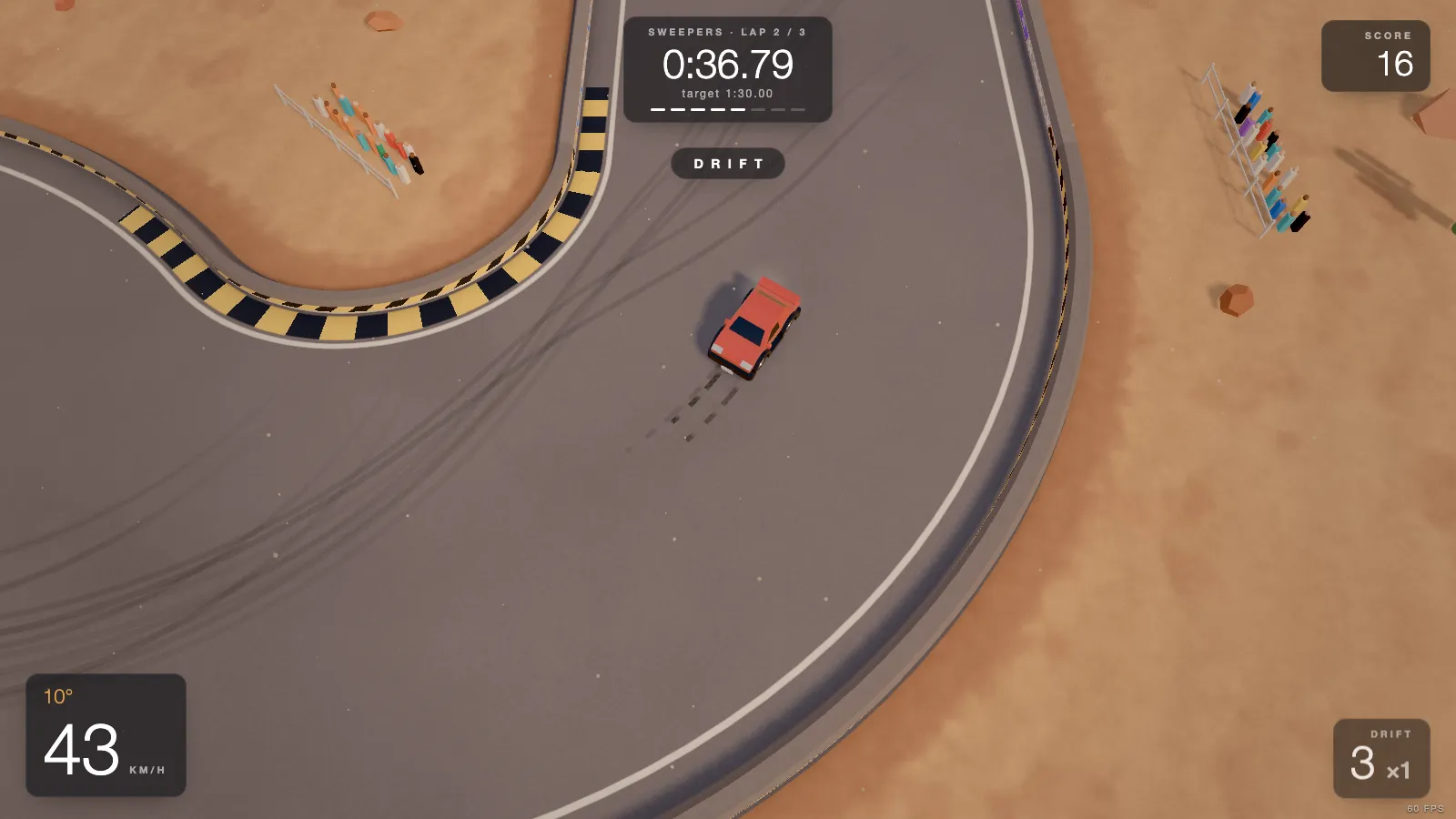
In short: drifting is cornering with the rear tyres sliding on purpose. The driver breaks the rear loose (handbrake, weight flick, brakes or power), counter-steers so the car stops rotating, and holds the angle with the throttle. Technically a car is drifting when its rear tyres slip at a bigger angle than its front ones. It looks fast, but it is judged on angle and style, not lap time.
1. Grip has a ceiling
A tyre pushes the car sideways only because it is twisted slightly against the direction it rolls. That small twist is the slip angle. The more slip angle, the more sideways force, up to a point. Past that point the tyre is at its ceiling: twist it further and the force stops growing, then drops, and the tyre starts to slide.
In DRIFTIT the front tyres reach their ceiling at about 8° of slip and the rear ones at about 10°. The rear axle also has more grip in total (6.4 m/s² of sideways acceleration against 5.6 for the front). That is deliberate: a car with a stronger rear is stable when you just drive it. Turn hard on clean grip and the front gives up first, so the car runs wide. That is understeer, and it is the safe, boring way to lose a corner.
2. Oversteer: the rear lets go first
Drifting needs the opposite: the rear has to run out of grip before the front. Then the tail swings outwards, the car rotates more than the corner asks for and its nose points inside the bend. That is oversteer. Left alone, oversteer ends in a spin. Held on purpose, it is a drift.
The other key fact: a sliding tyre grips less than a rolling one. Engineers call it static against kinetic friction. Once the rear in DRIFTIT is sliding it keeps only 62% of its grip, and it takes about 0.45 s to hook up again after you ease off. This is why a drift is a state rather than a moment: once the rear is loose, it stays loose until you let it grip.
3. How to get the rear to slide
Real drivers have a handful of ways to break the rear loose: the handbrake, a sharp flick of weight from one side to the other, braking into the corner so the rear goes light, or simply too much power. A game car usually gives you the first and the last.
- Handbrake. It locks the rear wheels. A locked tyre can't roll, so it can't make much sideways force either: in DRIFTIT a full handbrake leaves the rear with 10% of its sideways grip, and grip goes in about 0.04 s. The rear behaves like a puck on ice and the car rotates almost on the spot. This is why the handbrake is the easy way in on a keyboard.
- Power oversteer. A tyre has one budget of grip to spend on pushing forward and pushing sideways. Floor the throttle in a rear-wheel-drive car and the rear spends most of that budget on driving forward, so it has less left to hold the corner. DRIFTIT's car is rear-wheel drive, and full throttle takes away up to 60% of the rear's sideways grip. Never all of it: that is why a car with the wheel straight and the pedal pinned settles at an angle instead of spinning forever.
- Brakes. Hard braking moves weight forward and makes the rear light; in the game full brakes take about 30% off the rear's grip. Brake while turning in and the tail gets eager.
4. Drift angle: the number on the dial
The drift angle is the gap between where the car points and where it actually goes (see the diagram above). There are a few ways to measure it; DRIFTIT measures it at the rear axle, because that is the end of the car that is sliding, and shows it in degrees on the HUD next to your speed. The game counts you as drifting once that angle passes 10° at more than 4 m/s (about 14 km/h). Below that you are just cornering hard.
Drift judges and drift games pay for angle, and DRIFTIT does too: points build from speed × (angle ÷ 45°)1.2. The power of 1.2 means angle counts a bit more than linearly, so a 60° slide earns more than twice a 30° one at the same speed. The full scoring rules, multiplier included, are in our how to drift guide.
5. Counter-steer: steering against the corner
Once the tail is out, the car keeps rotating unless something stops it. That something is counter-steer: you turn the front wheels against the corner, in the direction the rear is sliding. In a right-hand bend with the tail out to the left, you steer left. Now the front wheels point roughly where the car is actually going, the front tyres pull the nose back, and the rotation stops at the angle you chose.
How much counter-steer? Enough to match the slide. Too little and the car spins; too much and the front tyres pull the car straight, the rear grips again and the drift is over (sometimes with a snap the other way, called a tank-slapper). Real drift cars get extra steering lock for exactly this reason.
On a keyboard you can only press a key or not, so DRIFTIT helps: while the rear is sliding the game turns the front wheels 82% of the way towards the direction of travel by itself, and your steering keys act relative to the slide. Hold the key into the corner to deepen the angle, tap the other way to reduce it. Let go of the steering entirely and the car straightens itself in about two seconds. It feels like a real car with a calm driver's hands already on the wheel, and it is why you can drift with four keys at all.
6. Throttle holds it, speed sets the size
Counter-steer stops the rotation; the throttle keeps the rear sliding. Lift off and the rear finds grip, the car straightens and the drift ends. Add throttle and the rear loses a bit more grip, so the angle grows. Drifters say they steer with the throttle, and that is literally true: in the middle of a long slide your right foot decides the angle and your hands only follow.
The car's steering also depends on speed. DRIFTIT's front wheels turn up to 35.5° when you are slow, about 20° at 72 km/h and only 7° at about 160 km/h, much like a real car, where a full turn of the wheel at speed would be a crash. So fast drifts are shallow and smooth and slow ones are wild; at walking pace you can spin donuts. With full lock and full throttle the car settles into donuts at around 40°.
7. The transition: from one side to the other
Between a right-hander and a left-hander the car has to swing its angle across: the transition, or flick. Ease off the throttle for a moment so the rear grips and the car swings back, steer the new way as it passes straight, and get back on the throttle to break the rear loose on the other side. Done well, the car never stops sliding, and in a game with a drift multiplier that is where the big scores are: DRIFTIT's multiplier climbs only while the slide is unbroken. Tracks like Esses and Chicane are built around it.
8. Is drifting the fast way round?
Mostly no, and the physics says why: a sliding tyre grips less and a spinning tyre wastes power. In DRIFTIT a sliding rear passes on only 60% of the engine's push. Drifting is judged on style. The exceptions are loose surfaces (rally drivers slide because gravel never grips well anyway) and very tight hairpins, where a quick rotation can beat a slow grip turn.
That trade-off is the whole game in DRIFTIT's timed tracks: three laps against a target time with the leaderboard ranking your fastest total. The best runs slide just enough: a quick rotation into Hairpin, a shallow, fast arc through Sweepers, grip on the straights.
9. Where drifting comes from
Drifting grew up in Japan in the 1970s and 1980s, on mountain passes and in touring-car racing. Racer Kunimitsu Takahashi made the sideways style famous, and Keiichi Tsuchiya, known as the Drift King, turned it into a discipline of its own. By the 2000s it had judged competitions in Japan, the US and Europe, scored on line, angle, speed and style rather than on who finishes first. That is also how most drift games score you, DRIFTIT included: drift scoring explained covers the details.
Practise it in a game, a simulator or on a closed course: on a public road a drift is just a car out of control.
Try it: what to feel for
Reading about grip only goes so far. Open the game on the Oval and try these, one at a time:
- Understeer: no handbrake, full throttle, turn in late. The car runs wide. That is the front at its ceiling.
- Oversteer: same corner, tap Space as you turn in. The tail steps out. Watch the angle on the HUD jump.
- Counter-steer: as the tail comes round, steer the other way. The rotation stops.
- Throttle balance: now hold the slide round the whole bend with the throttle alone: more for more angle, less for less.
Then read the step-by-step how to drift with a keyboard guide, or browse all 20 tracks. If you want the view from above explained, we wrote about top-down drift games too.