How real drift competitions are judged
In Formula DRIFT, the US professional series, each qualifying run has been judged on three things, as the series explains in its own Formula DRIFT 101 guide:
- Line. The judges lay out the path they want before the event, marked by inner clipping points (touch these with the front of the car) and outer clipping zones (swing the rear through these). The course is set so that a good run uses the track from wall to wall. Scored up to 25.
- Angle. How much slip angle the car holds over the whole run, rewarded for being at the limit in as many places as possible, with few steering corrections mid-corner and smooth transitions. Scored up to 25.
- Style. Smoothness and excitement: aggressive flicks, how close the driver dares to go to walls, difficulty and fluidity. A dedicated judge gives up to 30, and the line and angle judges each add up to 10, for a run total of 100.
That is changing. For 2026, Formula DRIFT announced that line and angle in PRO qualifying are now scored entirely by a telemetry system (called UDSM) from vehicle data: about 80% of the score. The remaining 20%, style, stays with the panel of three judges, because difficulty is hard to measure.
Japan's D1 Grand Prix judges on speed, angle, showmanship and line (as summarised on Wikipedia). Speed is the one Formula DRIFT leaves out of its three headings: carrying momentum through a big angle is the hard part, because angle scrubs speed.
Tandem battles
After qualifying, the top drivers meet in pairs. Each heat is two passes, and each driver leads once. The lead car is judged on running a good qualifying-style line and pulling away while drifting; the chase car on matching the leader's line and angle while staying as close as possible. There is no points total here: the judges decide who won the pair, and if they cannot, the pair runs again (the "one more time" crowds chant for). Formula DRIFT's 2026 changes also let judges look at telemetry during battles, such as the gap between the cars and their angle and speed (Performance Racing Industry).
What a game can measure
A game knows the car's exact speed and angle at every moment, so it never needs an angle judge. What it struggles with is everything a human sees: was the line pretty, did it look committed? Most drift games therefore score speed × angle × time, add a multiplier for keeping the drift alive, and handle line through the track itself: walls, cones or zones. Style becomes the multiplier: one long, flowing slide beats many short ones.
DRIFTIT's formula, exactly
DRIFTIT counts the car as drifting when the rear axle slides at more than 10° to its direction of travel and the car moves faster than 4 m/s (about 14 km/h). While it is drifting, points build up every moment:
points per second = speed (m/s) × (drift angle ÷ 45°)1.2 × 10
So 45° at 20 m/s (72 km/h) is worth exactly 200 points a second. Speed counts linearly: double it and you double the points. Angle counts slightly more than linearly because of the power of 1.2. Here is the table:
| Speed | 15° | 30° | 45° | 60° |
|---|---|---|---|---|
| 36 km/h | 27 | 61 | 100 | 141 |
| 72 km/h | 54 | 123 | 200 | 282 |
| 108 km/h | 80 | 184 | 300 | 424 |
Points per second, before the multiplier. Notice that 30° at 108 km/h (184) is worth less than 45° at 72 km/h (200): a bigger angle beats a faster but shallower slide, as long as the speed does not collapse.
The multiplier and banking
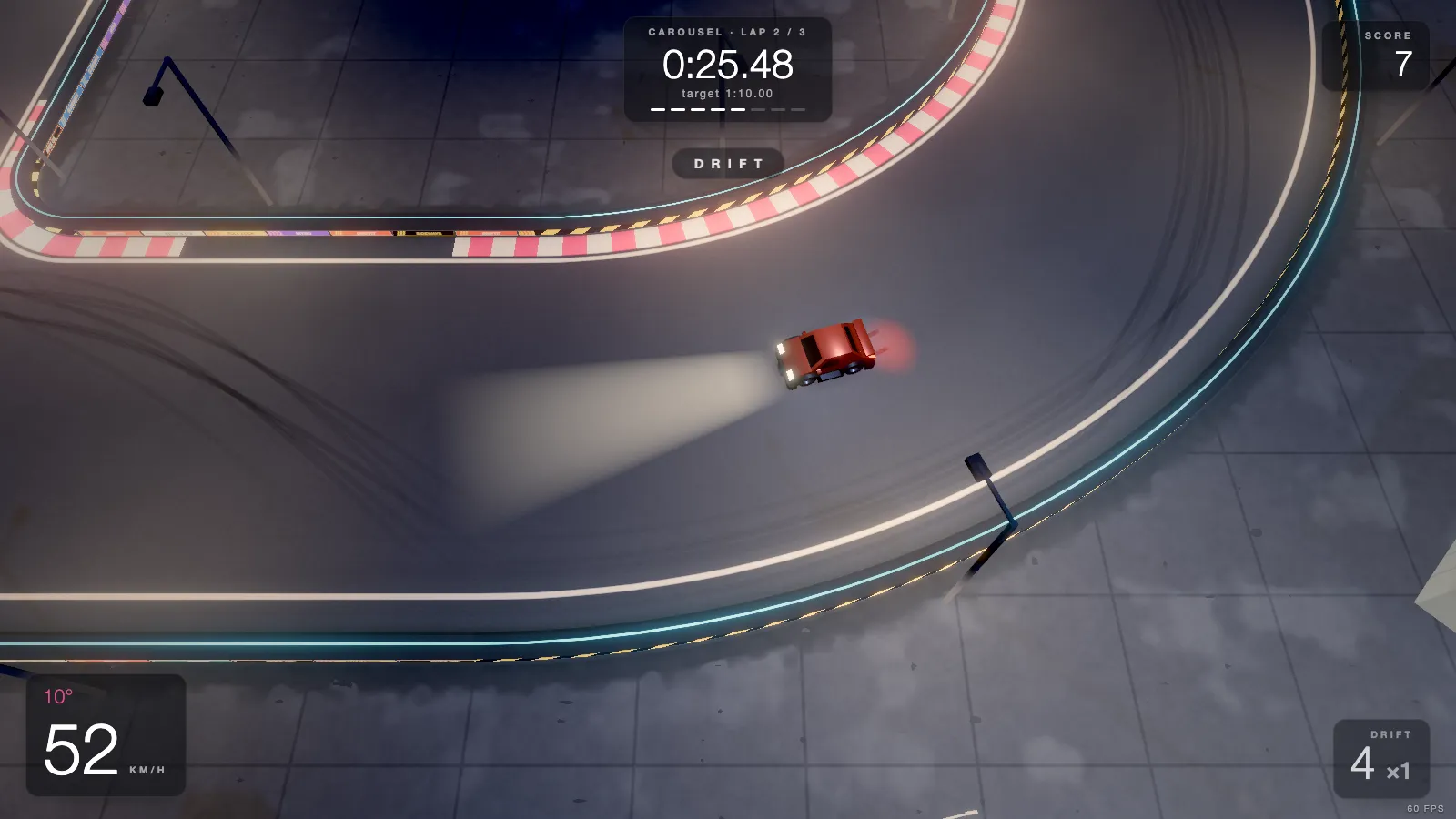
The points above go into the current drift, shown bottom-right on the HUD with its multiplier. Three rules decide what you keep:
- The multiplier starts at ×1 and rises by 0.5 for every 1.5 s of continuous drift, up to ×10. Reaching ×10 takes 27 s without a break.
- Banking. Once you have stopped drifting for more than 0.6 s, the drift ends: its points times the multiplier are added to your total (top right) and the multiplier goes back to ×1. A dip shorter than 0.6 s, like the moment a car swings from one side to the other, does not end the drift; the clock for the multiplier simply pauses while you are not sliding.
- Crashes. Hit a wall and the drift in progress is lost: nothing is banked. On timed tracks any wall touch also restarts the run.
That last rule is DRIFTIT's version of the line judge. There are no clipping points; the walls are the line, and touching one costs everything.
A worked example
Take a run of corners driven at a steady 35° and 72 km/h. That is 148 points a second. Now drive the same 10 seconds of sliding two ways:
| Four separate drifts | One linked drift | |
|---|---|---|
| Drift length | 2.5 s each | 10 s |
| Points before multiplier | 370 each | 1,479 |
| Multiplier at the end | ×1.5 | ×4 |
| Banked | 555 × 4 = 2,220 | 5,917 |
Same corners, same angle, same speed, and linking them scores about 2.7 times as much. Keep going for 27 s and every point is worth ten. That is why the guide to linking drifts matters more for your score than adding a few degrees of angle.
The one trap: a long drift is also a long time at risk. A wall at second 25 of a ×9 slide wipes out everything in it. Big scores come from slides you can actually finish.
Judging vs the game, side by side
| Formula DRIFT qualifying | DRIFTIT | |
|---|---|---|
| Line | Clipping points and zones set by the judges; since 2026 measured by telemetry | No clipping points; any wall touch loses the drift and restarts a timed run |
| Angle | Judged, now measured | Measured at the rear axle; counts to the power 1.2 |
| Speed | Part of style and angle (D1 judges it on its own) | Multiplies the points directly |
| Style | Three judges, about 20% of the score in 2026 | No judge; the multiplier rewards unbroken, flowing slides |
| Winner | Highest score, then tandem battles | Leaderboards rank the fastest three-lap time; the score is your own measure |
That last row is worth knowing before you chase points. Every one of DRIFTIT's 20 tracks is a time attack, and the online board ranks time only. A huge angle looks great and scores well, but it costs time (see how to get faster lap times). The server replays every submitted run from its recorded inputs and computes both the time and the score itself, so the numbers you see on the result screen are the ones the formula above produces, not ones a browser claims.
How to score more in DRIFTIT
- Link first, angle second. The multiplier can reach ×10; extra angle adds tens of percent.
- Keep speed through the slide. Points scale with speed, so a big angle that kills your speed is a bad trade. Hold the throttle and let the rear do the work.
- Pick tracks that flow. Snake and Esses chain bends together; the Carousel gives one long 270° slide.
- Finish the drift. A banked ×4 beats a lost ×8.
New to drifting altogether? Read drifting explained for why a car slides, then how to drift for the technique.